
EU AI Act
EU AI Act: Information for autofox Customers
Customer information on the use of Artificial Intelligence | As of: July 2026
fThe Most Important Point First
Nothing changes for the standard use of autofox under the EU AI Act. You can continue to use the platform as usual. In our assessment, now supported by official guidelines from the EU Commission, a visible label marking your vehicle images as "AI-edited" is not required for standard use.
Legal Basis
The EU AI Act (Regulation (EU) 2024/1689) creates a uniform legal framework for Artificial Intelligence in the EU. The transparency obligations under Article 50 apply from 2 August 2026 (Article 113). This deadline is fixed and is not affected by the currently discussed legislative amendments (the "Digital Omnibus"), which concern other parts of the regulation.
On 20 July 2026, the European Commission approved the content of official guidelines on Article 50 (interpretive guidance for authorities, providers, and users of AI systems). These guidelines expressly confirm the assessment presented below.
Does the EU AI Act Apply to autofox?
Yes. autofox uses AI to support professional vehicle image editing, in particular for removing vehicle backgrounds, replacing backgrounds with virtual showrooms, optimizing images, and reducing distracting reflections (Visual+). In our assessment, this does not constitute a high-risk AI system within the meaning of the EU AI Act. autofox fulfills the obligations that apply to the provider of an AI system; this creates no separate obligation for you as a customer.
Do You Need to Visibly Label Your Vehicle Images?
In our assessment, standard use of autofox does not create an obligation to visibly label edited vehicle images as AI-generated or AI-edited for end customers. A visible labeling obligation would only apply to you if an image constituted a so-called "deepfake", meaning it would falsely lead a viewer to believe that a vehicle looks different or is in a different condition than it actually is.
The Commission guidelines of 20 July 2026 give an example that closely matches the use of autofox:
Quoted from the guidelines (translated in substance):
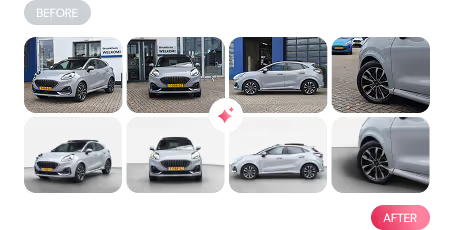
A real product (e.g. a car) shown in an advertisement against an AI-generated background does not constitute a deepfake, as long as the advertisement does not deceive the viewer about the actual appearance and characteristics of the product.
This is exactly the use case of the virtual showroom: the real vehicle remains unchanged, only the surrounding environment changes. A different assessment may be required if an image inaccurately represents the actual condition or material characteristics of a vehicle, for example if equipment, paint color, or condition is digitally altered.
What Changes for You as a Customer?
Your use of autofox remains unchanged. Please review edited images as usual before publication and make sure the actual condition of the vehicle is accurately represented. This is already required independently of the EU AI Act under competition law (Section 5 UWG, prohibition of misleading advertising). autofox continuously monitors further developments (including the final adoption of the guidelines and a possible code of conduct) and will inform you if anything changes for you.
Important Note: autofox's AI is designed for the professional presentation of vehicle images. It is not intended to alter the actual condition of a vehicle or conceal defects such as scratches, dents, stone chips, rust, or paint damage. Such use would constitute misleading advertising and is not permitted.
Questions?
Contact us at [email protected] or visit www.autofox.ai.
Note: This customer information serves general informational purposes and does not constitute legal advice. The applicable regulation is Regulation (EU) 2024/1689 (EU AI Act) in its respective current version. Sources: EUR-Lex, Regulation (EU) 2024/1689, in particular Article 50 and Article 113; Communication to the Commission C(2026) 5054 final of 20 July 2026 (Guidelines on the implementation of the transparency obligations for certain AI systems under Article 50 of the AI Act).